|
Touma Audo
Who made the East- Aramean Nestorians known as "Assyrians"?
SUA/WCA and allowing terrorism
Aramean history, culture and language, a six partite interview
21-1-2013: Iraq: Aramean teacher and student killed in Mosul
22-2-2012: Iraq: We have left behind a "sovereign, stable and self-reliant Iraq"
19-8-2011: Iraq and Arameans: The usual ritual, blowing up their churches
7-6-2011: The uproar in the Middle-East and the future of the Aramean nation
29-4-2011:
“Liberation” of
23-11-2010: Aramean blood continue to flow in Iraq: Two Aramean brothers killed in Mosul
11-11-2010: An Aramean spiritual leader makes a dramatic appeal: Leave Iraq
1-11-2010: Bloodbath among the Arameans of Baghdad: Something like this never happened
17-5-2010: Iraq: The 19 years old Aramean girl Sandy Shabib Hadi Zahra succumbs to her injuries
10-3-2010: Exodus Arameans from Mosul: According to recent UN report more than 5000 Arameans have left Mosul
27-2-2010: Council of Churches in Iraq appeals to the government to protect the Aramean people in Mosul, Iraq
26-2-2010: The Arameans of Mosul: A new Exodus and Ethnic cleansing is going on
18-2-2010: The Arameans of Iraq again victim of killings and bloodbaths:
24-12-2009: A Christmas “message” for the Arameans of Mosul: Four Aramean Churches attacked and one Aramean killed
1-9-2009: Arameans of Iraq: The East- Aramean Chaldean bishop Louis Sako of Kirkuk sounds the alarm bell
29-8-2009: Totally unfounded or has it a grain of truth in it? Greater- Israel and the ethnic cleansing of the Arameans of Mosul and surroundings in Iraq
13-7-2009: Seven Indigenous Aramean Churches in Baghdad (Iraq) attacked by car bombs
4-5-2009: Aramean blood continues to flow in Iraq…
15-11-2008: Iraq: The bloodshed of Aramean people and bombardment of churches continues undiminished
27-10-2008: Attempt of ethnic cleansing Mosul: The Aramean Srebrinica. Who is responsible and why?
2-9-2008: Again two Arameans killed in Iraq
Killing of Priest Yusuf Adel Abudi
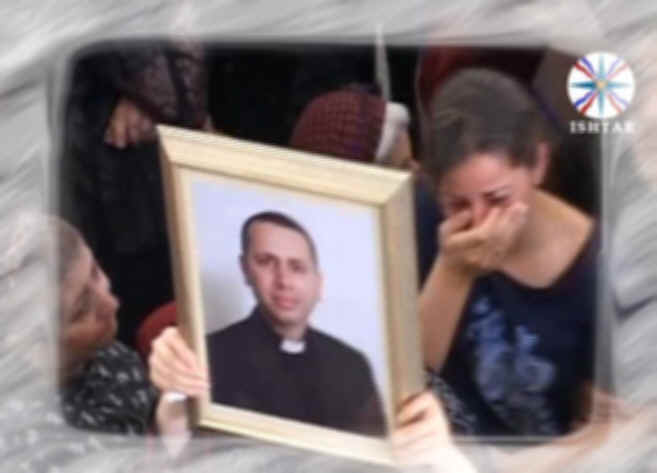
4-5-2008: Again a Aramean spiritual leader is killed in Iraq. This time: The West- Aramean Syrian orthodox priest Yusuf Adel Abudi in Bagdad
11-4-2008: Through all the misery: Miracles happens in Iraq
6-4-2008: Funeral of the West- Aramean Syrian Orthodox Priest Yusuf Adel Abudi
Killing of Mgr. Faraj Raho
1-3-2008: East- Aramean Chaldean bishop of Mosul, Mgr. Paulus Faraj Raho was abducted on 29-2-2008 in Mosul.
13-3-2008: The East- Aramean Chaldean bishop Paulus Faraj Raho killed in Mosul
14-3-2008: Friday 14-3-2008: Funeral of Mgr. Faraj Raho in St. Addai Church in Karemlesh
16-3-2008: Mgr. Paulus Faraj Raho: A Great Spiritual Leader and a Worthy Sheppard in Charge of Jesus Christ
23-2-2008: Aramean centre for art and culture has been opened in Ankawa, northern Iraq
7-1-2008: Aramean Churches and institutions in Iraq under Attack
Killing of Priest Ragied Aziz Gannie
25-5-2007: Terror against Arameans (including "Assyrians" and Chaldeans) of Iraq. Ethnic cleansing of the Indigenous people of Iraq
Killing of Isoh Majeed Hadaya
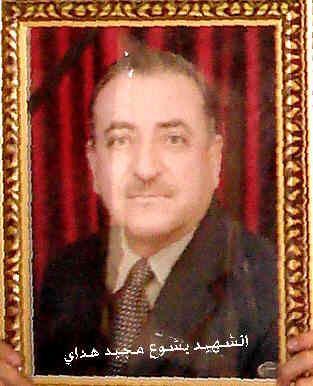
22-11-2006: The West- Aramean Isoh Majeed Hadaya killed by terrorists in Iraq
Killing of Priest Paulus Iskandar
12-10-2006: Aramean priest Iskandar beheaded in Mosul (Iraq) |
Aramean people: Aramean people (not to be confused with ‘Armenians’) speak Aramaic, the language spoken by Abraham, Moses and Jesus. They are the indigenous people of what was called in ancient times Aram- Nahrin, in our days it is called ‘Mesopotamia’. Some Arameans today identify themselves with “Assyrians”, because of the spiritual colonial hate generating activities of the Western missionaries and diplomats in the Middle-East in 16th and 19th centuries. Other Arameans became known as “Chaldeans”. However all of them are Arameans.In Turkey, the Arameans are called: Süryani. In Arabic they are called Al- Suryan. Council of Churches in Iraq appeals to the government to protect the Aramean people in Mosul, Iraq.
The Council of churches in Iraq was established on 9th of February 2010 in Baghdad in the Armenian monastery St. Garabed. The Chairman of the Council is the Armenian bishop Avak Asadourian and the Secretary is the West- Aramean Syrian Catholic bishop Baelius Qas Moussa.
According to the press release issued on 10th of February 2010, the council consists of 14 recognized churches in Iraq (see below).
The Aramean denominations are church number 1, 2, 3, 4 ,5 ,8, 10 and 12. The term “Greek” does not refer to the nationality, but rather to the Aramean churches who in the 5th century adhered to the Roman (RUM) Emperor and therefore they are also called “Melkites”.
In the statement of the Council the important contribution of Christians of the Middle-East to the society is being underscored. Regarding the persecutions of the Christians of Iraq, the Council says “…forces of evil carrying devilish agendas”. But “….our Christian faith teaches us to persevere against the forces of darkness”, says the Council. Regarding the land of the two rivers, the council says “….keep creating the good and the beautiful as we have always done in the land of the Tigress and the Euphrates “
The Council of Churches in Iraq makes appeal to the Iraqi Government “…to do its duty by maintaining peace and security for all the citizenry of Iraq..”
The complaint of the Arameans now as well as in 2008 was and is that the government institutions are very lazy and factually are just looking how the Aramean people being killed and expelled out of Mosul. Following the killing of 20 year old Aramean student Wissam George in Mosul on Wednesday 17th of February 2010, the bishop of Baghdad Mgr. Sleimun Warduni was completely dazzled saying “We are very sad. The government is looking at what is going on, it is speaking, but doing nothing”
The communiqué of the Council of Churches in Iraq was issued on 23rd of February 2010. According to the last reports already hundreds of families have left Mosul. The American forces patrol in Mosul, but do nothing to prevent this happening. In Mosul there are the East- Aramean Chaldeans, the East- Aramean Nestorian “Assyrians”, the West- Aramean Syrian Catholics and the West- Aramean Syrian orthodox.
In 2008 more than 12.000 Arameans were expelled out of Mosul. Some of them later came back, while others fled to the West or the neighboring countries. The number of Aramean Christians still living in Mosul is estimated between 10.000 and 15.000.
In the communiqué of 23rd of February 2010 the Council appeals also to the churches worldwide and says “We also call upon the Churches throughout the globe and the people of good will as well to make their voices heard in whatever peaceful and diplomatic means it is available to them”
Media reports: http://www.aramnahrin.org/English/Media_Reports_Arameans_Mosul.htm
The Arameans of Iraq
Before the war of 2003, there were around 800.000 Arameans in Iraq. Probably more than half of them have left the country. The attacks on their churches and leaders chased the Arameans out of Iraq.
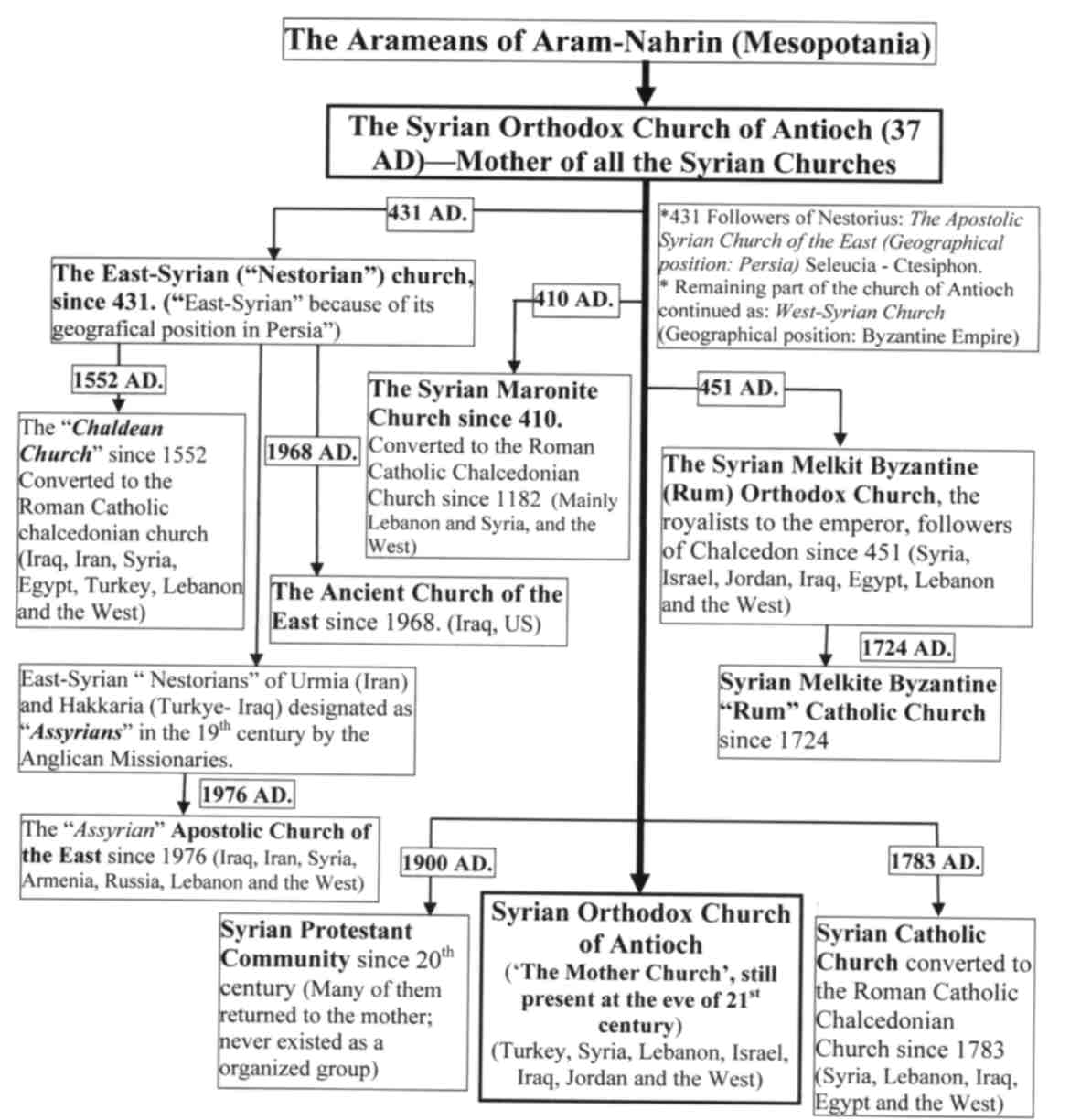
The spiritual/political colonial Western intervention and machinations in the Middle-East divided the Arameans in various denominations, namely:
The terms “East- “ and “West- Arameans” go back to the time of early Christianity where the Aramean indigenous nation was geographically termed as such. Roughly speaking the Euphrates River was the border. Those Arameans living Eastern of Euphrates, thus living in Persia, were termed “East- Arameans” and those living Western of Euphrates, thus in Roman Empire, were called “Western- Arameans”. The designations “Chaldeans” and “Assyrians” for the eastern Arameans go back to the Western colonial activities of the 16th (France + Catholic missionaries) and 19th (Great Britain + Anglican missionaries) centuries. The ecclesiastical and political Western powers closely worked together and setup camps in Turkey, Iraq, and Iran where the Aramean children were “educated” through which they were completely uprooted from their Aramean origin. They thereby planted a horrible form of fanaticism in their hearts which caused them to display an immense aversion to their Aramean origin.
In the year 1553 the Western Catholic missionaries together with France brainwashed a part of the East- Aramean clergy by means of bribery to call themselves “Chaldeans” with the result that the Aramaic language became known as “Chaldean” language and a part of the Aramean nation became known as “Chaldean” nation in some parts of the Western literature, the first attack on the Aramean heritage.
As a result of mutual hatred and competition between the Western Catholics and Protestants, in the late 19th century the same process was repeated, this time by the Anglican missionaries and Great Britain, and the other part of the East- Aramean “Nestorian” tribes of Hakkari (bordering Turkey and Iraq) and Urmia (Iran) to call themselves "Assyrians"- a term which was used purely geographically and only applied to the "Nestorians". The result was that Aramaic became known as “Assyrian” language and the Aramean nation as the “Assyrian” nation- this was the second and more severe attack on the Aramean heritage- a kind of spiritual genocide.
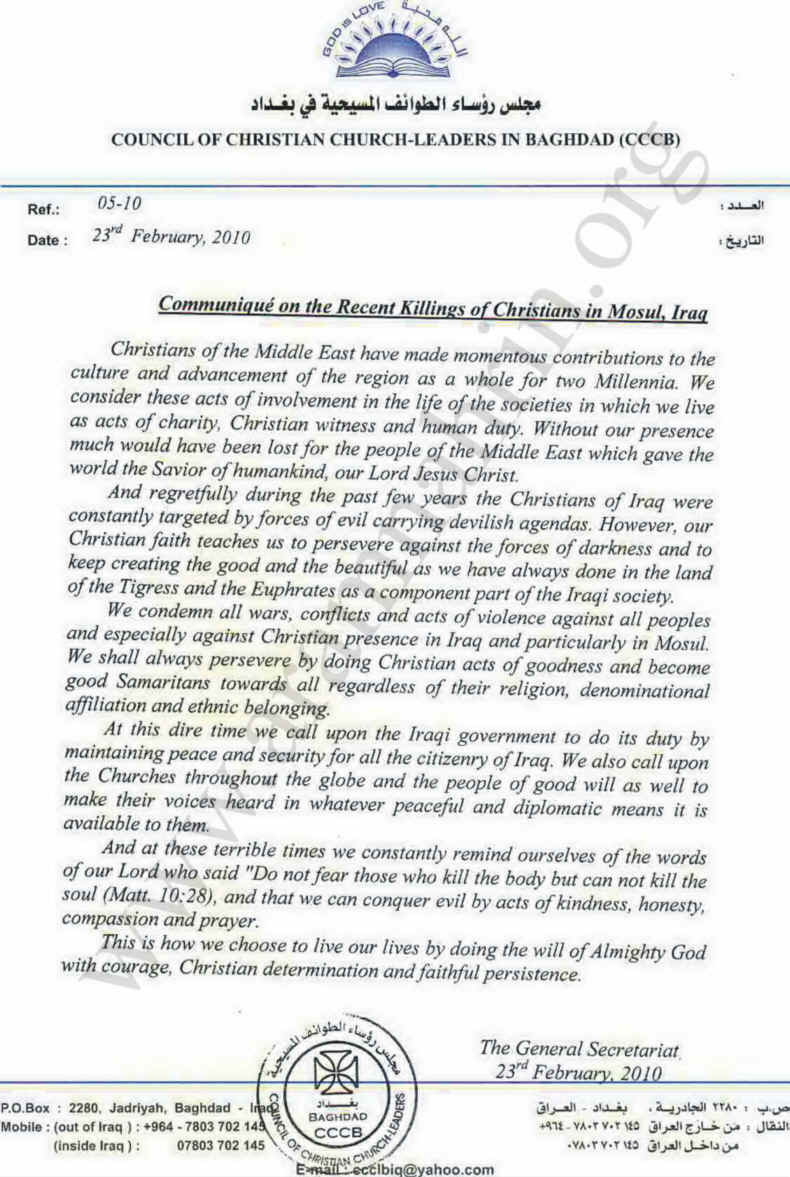
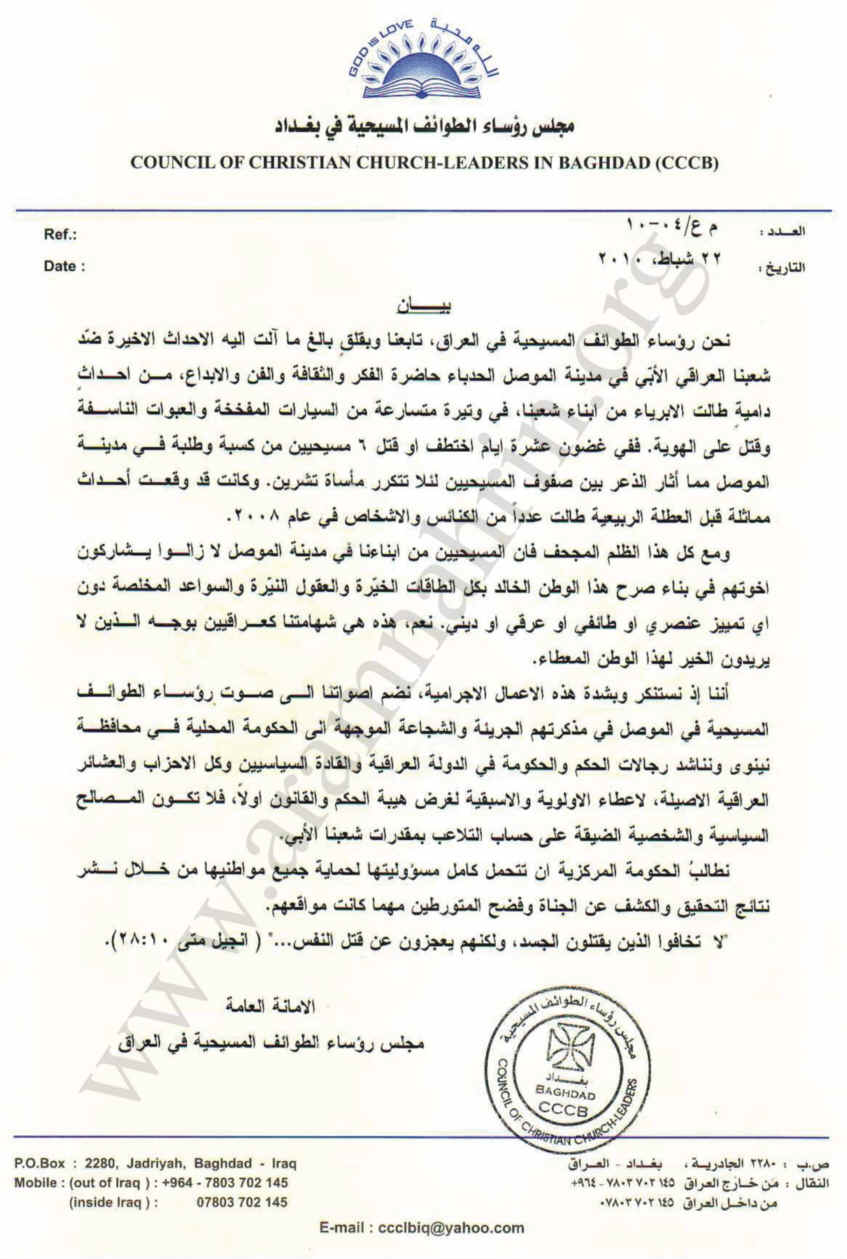
Communiqué on the Recent Killings of Christians in Mosul, Iraq
Original English version: http://www.aramnahrin.org/Photo/Letter_Council_ChristianLeaders_Baghdad_English_23_2_2010.jpg Original Arabic versio: http://www.aramnahrin.org/Photo/Letter_Council_ChristianLeaders_Baghdad_Arabic_23_2_2010.jpg
Ref.: 05-10 Date: 23 February 2010
Christians of the Middle East have made momentous contributions to the culture and advancement of the region as a whole for two Millennia. We consider these acts of involvement in the life of the societies in which we live as acts of charity, Christian witness and human duty. Without our presence much would have been lost for the people of the Middle East which gave the world the Savior of humankind, our Lord Jesus Christ.
And regretfully during the past few years the Christians of Iraq were constantly targeted by forces of evil carrying devilish agendas. However, our Christian faith teaches us to persevere against the forces of darkness and to keep creating the good and the beautiful as we have always done in the land of the Tigress and the Euphrates as a component part of the Iraqi society.
We condemn all wars, conflicts and acts of violence against all peoples and especially against Christian presence in Iraq and particularly in Mosul. We shall always persevere by doing Christian acts of goodness and become good Samaritans towards all regardless of their religion, denominational affiliation and ethnic belonging.
At this dire time we call upon the Iraqi government to do its duty by maintaining peace and security for all the citizenry of Iraq. We also call upon the Churches throughout the globe and the people of good will as well to make their voices heard in whatever peaceful and diplomatic means it is available to them.
And at these terrible times we constantly remind ourselves of the words of our Lord who said “Do not fear those who kill the body but can not kill the soul (Matt. 10:28), and that we can conquer evil by acts of kindness, honesty, compassion and prayer. This is how we choose to live our lives by doing the will of Almighty God with courage, Christian determination and faithful persistence.
COUNCIL OF CHRISTIAN CHURCH-LEADERS IN BAGHDAD (CCCB) Office of the General Secretary
Press Release Date: 10 February 2010 Establishing The Council of Christian Church-Leaders of Iraq
Through the initiative of the Heads of Churches in Iraq, a new council was established in the name of "The Council of Christian Church-Leaders of Iraq", which includes all of the patriarchs, archbishops, bishops, and heads of churches in Iraq, from the Catholic, Orthodox, Oriental and Protestant families, constituting 14 communities and comprised of28 Dioceses.
The meeting to launch the Council was held in the monastery of St. Garabed of the Armenian Orthodox Church in Baghdad on Tuesday, February 9, 2010. Participating in this constituent assembly were His Beatitude Cardinal Emmanuel III Deliy, the Chaldean Patriarch of Babilon. and His Beatitude Mar Adai II, Patriarch of the Ancient Church of the East, with all the archbishops, bishops and heads of churches in Baghdad, and the archbishops and bishops from the northern region, representing their parishes or authorized by fellov.' bishops of other dioceses.
The aim of the new Council is "to unite the opinion, position and decision of the Churches in Traq on issues," related to the Churches and the State, for the "upholding and strengthening the Christian presence, promoting cooperation and joint action without interfering in private matters of the churches or their related entities," as stated in Article III of the of the bylaws of the Council
The bylaws were the subject of previous meetings, deliberations and extensive studies by the heads of churches, the bishops and concerned dioceses, together with lay expelis in legal matters. The revised draft of the bylaws was discussed during the launching meeting, and necessary amendments were made before officially founding the Council.
The Council will be involved in activating dialogue and ecumenical initiatives among member churches, as well as with churches and heads of churches around the world. It will activate dialogue and relations with our Muslim brothers and sisters and promote the acceptance of the other. It will attend to the issue of Christian education, and the renewing of religious curriculum in public schools in coordination with concerned governmental institutions. It will work toward making a civil status law for Christians in Iraq, and will promote the participation of Christians in public life based on the rights of citizenship and partnership in building the nation, as a tent and a house for all.
The Council is composed of a general assembly which includes all constituent Church Leaders, and a secretariat consisting of 6 persons. These executives are: the General Secretary and his assistant for the northern region, Media Manager, a rapporteur, a secretary to the General Secretary, and a treasurer. The General Secretariat will be based in Baghdad.
The election of the General Secretary was accomplished by secret ballot for a first term of three years, renewable one time only. HE Avak Asadourian, Ph.D., the Archbishop of the Armenian Orthodox Church in Iraq was unanimously elected General Secretary, and HE Basilius Guirgis al-Qass Moussa, the Archbishop of Mosul for the Syrian Catholic Church, and the rapporteur of the council of bishops of Nineveh, was elected assistant General Secretary.
The churches included by the "The Council of Christian Church-Leaders of Iraq" are those Christian churches recognized by the Iraqi State, as contained in the Official Gazette "al-Waqa'e' al-lraqiyeh" in its issue no. 2867, dated January 18, 1982:
1. The Chaldean Community (the Chaldean Church) 2.The Assyrian Community (the Ancient Church of the East) 3.The Assyrian Catholicosate Community (the Assyrian Church of the East) 4.The Syrian Orthodox Community (the Syrian Orthodox Church) 5.The Syrian Catholic Community (the Syrian Catholic Church) 6.The Armenian Orthodox Community (the Armenian Orthodox Church) 7.The Armenian Catholic Community (the Armenian Catholic Church) 8.The Greek Orthodox Community (the Greek Orthodox Church) 9.The Greek Catholic Community (the Greek Catholic Church) 10.The Roman Catholic Community (the Latin Church) 11.The National Evangelical Protestant Community (the Presbyterian Church) 12.The Evangelical Protestant Assyrian Community 13.The Seventh Day Adventist Community (Adventist) 14.The Coptic Orthodox Community (the Coptic Orthodox Church)
We implore the Creator to bestow
His grace and blessings on the new council, asking our faithful to keep us
in their prayers.
The General Secretariat 10 February 2010
Copyright © Aram-Nahrin Organisation
|
Letters to governments and international institutions
Aramean Spiritual/ Physical Genocide
Fake News on the Aramean nation:
1-12-2009: Aramean Organizations sent a letter to the new elected president of the European Union
10-14 August 2009: Aram-Naharaim attends the annual meeting of the UN Expert Mechanism On the Rights of Indigenous Peoples. Statement on the situation of the Aramean people in Syria, Turkey and Iraq
25-4-2008: Aramean Organisations ask for protection of Aramean spiritual leaders in Iraq
22-8-2007: Aram-Nahrin sends a letter to President George Bush, President Nicolas Sarkozy and Prime Minister Gordon Brown
31 July - 4 August 2006: Aram-Naharaim attends the 24th session of the Working Group on the Indigenous Populations
* Aramaic language in danger: Shall the language of Abraham, Moses and Jesus disappear?
* Proposal: Media Ombudsman for Indigenous Peoples.
* Report of Aram-Naharaim: A great success for the Aramean cause …. the Arameans and the UN…..
20-10-2005: Aram-Naharaim in action for the Arameans in Iraq
18-22 July 2005: Aram-Naharaim attends the 23rd session of the Working Group on the Indigenous Populations: A statement on “Spiritual Colonialism and the decline of the Indigenous Aramean people of Aram-Nahrin”
19-23 July 2004: Aram-Naharaim attends the 22nd session of the Working Group on the Indigenous Populations. Statement: The exclusion and discrimination of the Indigenous Aramean people of Mesopotamia (Aram-Naharaim)
|